Small teams
I used to think bigger companies have it all figured out.
That’s until I started joining the workforce, and realised theres no “secret” to doing work, and the most valuable things need to be “figured out” by key owners at some point in time.
Once I built my own startup and my own business it became even more apparent.
Bigger companies have an engine built, you just need to maintain it.
In smaller companies, you build the engine.
You can do big things with small teams, but it’s hard to do small things with big teams. And small is often plenty. That’s the power of small, you do what needs to be done rather than overdoing it.
Nobody can hide behind anyone or anything. Your deliverables are clear, and your work needs to show it off. You have a clear result you’re driving and you are sticking your neck out for it.
Win or lose, it will depend on you.
In bigger teams, there’s this diffusion of responsibility.
Productivity drops as group size increases, picture yourself in a small zoom call with 2 person. Now 3. You probably need to engage in a conversation.
As the group grows bigger, with 4, 5, 6 and even more people in it, you instantly have less incentive to contribute because you think “somebody else” will do it.
Things just move slower in bigger teams. More alignment needed, more feelings to worry about, more mistakes that can happen.
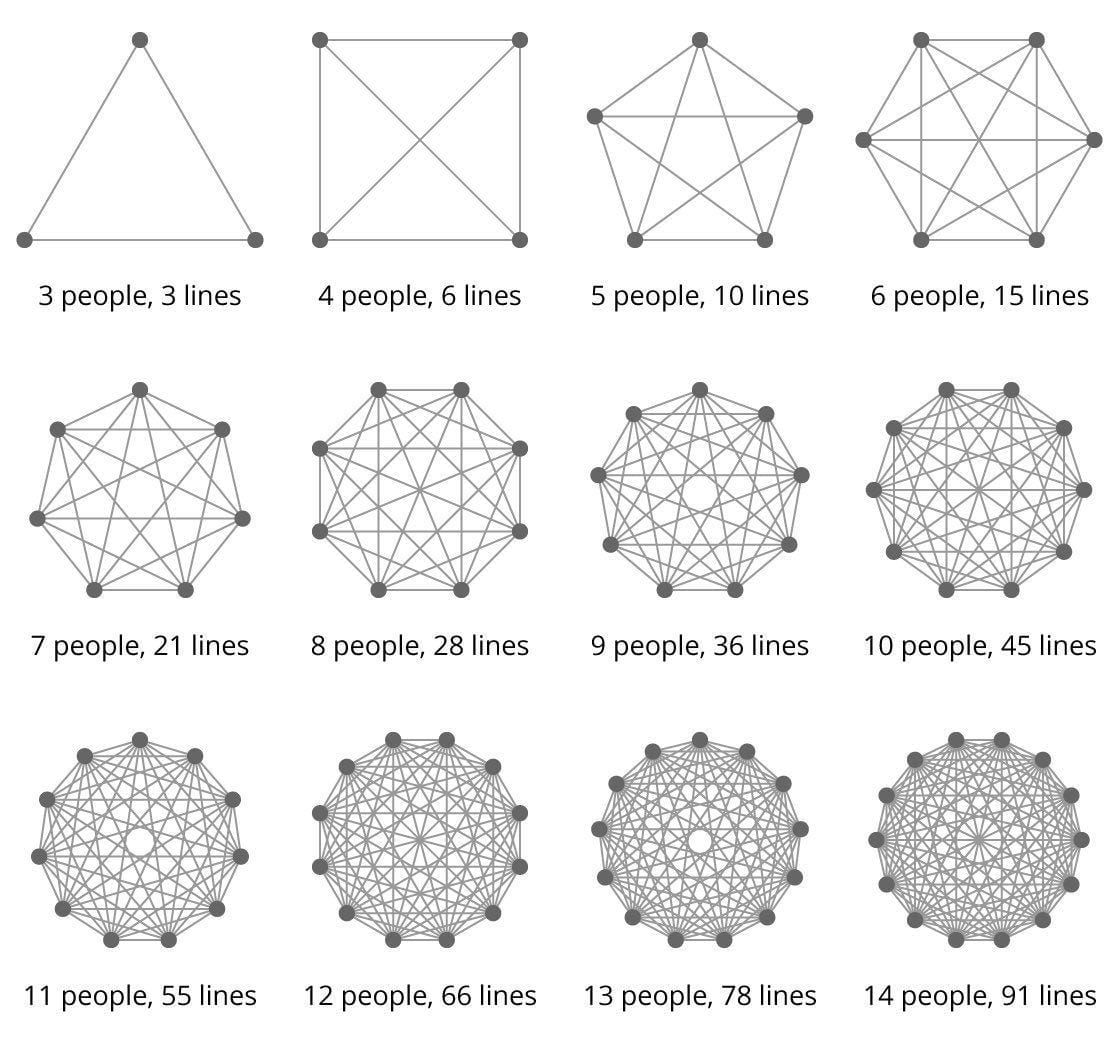
See the photo above. Complexity increases exponentially with more people.
This one picture itself should help you understand this concept.
If you're a builder who wants to be productive in your career, make a real impact & build something meaningful to your customers, a small team of killers is all you need.
Small teams decide faster
Fewer approvals, fewer alignment meetings, fewer memo layers, fewer veto points
Speed is a function of how many people must agree before motion is allowed.
Small teams create moral pressure to contribute.
Small teams force product truth
Big teams can hide bad ideas under things like - slides, committees, pilot programs, “exploration phases”.
Small teams must ship reality.
Small teams meet reality sooner. Reality is the best consultant. No fluff.
Small teams are harder, and that’s the point
Small teams mean context switching A LOT, multi-hat roles, discomfort, skill stretch (some days you feel like you don't know how to do your job at all and you have new problems to solve)
But stretch builds capability density.
See it as uncomfortable gyms, instead of comfortable couches.
Small teams NEED A-players
Talent density > headcount. Fewer, stronger people beats many average. It forces us to replace roles with capability, not number of headcount.
Headcount is not capacity. Capability is capacity.
Small teams reduce politics surface area
Politics grows with role overlap, unclear ownership, layered reporting, credit ambiguity.
Small teams have clear lines, everyone knows who's doing what and who's responsible for what. There's direct attribution to each person (if there isn't, what are you even doing here).
Politics is a side-effect of excess structure.
Small teams compound culture faster
In small teams: behavior spreads quickly, standards spread quickly, sloppiness spreads quickly too. Culture half-life is short.